
Unthinkable Thoughts for Memorial Day
Heroes Or Victims?

Likes on a post are motivating. Paid subscriptions are enabling. If not, buy me a coffee? Joyful Resistance has a hunger for justice and a thirst for caffeinated beverages.
Prior to the tip-off of an NBA game on Memorial Day announcer Mike Tirico made the usual statement about honoring those who gave their lives to preserve our freedoms - such as the ability to watch the game.
Hearing this, I had a dangerous thought that Noam Chomsky would describe as “beyond the boundaries of thinkable thought,” i.s., beyond common sense.
How long has it been since U.S. Armed Forces engaged in a conflict that was necessary to protect our freedoms?
I carefully examined this timeline of 172 military actions since 1945. https://en.wikipedia.org/wiki/Timeline_of_United_States_military_operations
Two actions seemed remotely justifiable, even though not related to defending the freedoms of Americans.
One is the first Gulf War that pushed back Iraqi forces after they invaded Kuwait, Another is the costly Korean War that began with a UN Security Council Resolution and became a successful attempt at collective military security. It involved forces from 16 western-allied nations - the U.S. bearing the heaviest burden.
There were some that might qualify as indirectly protecting the U.S., e.g., the assassination of Osama bin Laden and air attacks on ISIL forces in Iraq and Syria. We could try to stretch to include the unsuccessful war in Afghanistan. This was purposed as an attempt to overthrow the Taliban government that had protected the ISIL training of the Saudi nationals who perpetrated the 9/11 attacks.
But that’s it, and that’s a stretch.
This history of military operations since WW2 (and the same could be said for actions before WW2) is a chronicle of interventions in countries that posed zero threats to the people of the United States. Many were unsuccessful, as in Afghanistan and Vietnam (and Iran) at enormous human costs.
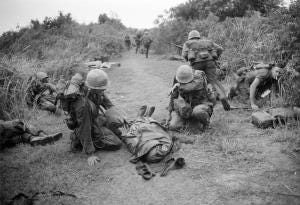
Most were attempts to prop up national governments that were open to U.S. corporate control of their economies (an openness facilitated by payoffs) and extremely hostile to unions and pro-democracy forces in their countries.
Where successful, U.S. intervention created sweet deals for corporate extraction of natural resources and cheap labor markets in developing countries, thus depressing wages for American workers.
Who Do Wars Benefit?
So, in this Memorial Day week I feel free to consider the true purpose of wars and the importance of war resistance.
When we are told to honor the patriots who gave their lives, I am reminded of the World War II memorials I saw twenty years ago in a mountain top chapel in the German Alps. “Fur das Vaterland” “Sie gaben ihr Leben für uns.,” Für Gott und Vaterland.”1
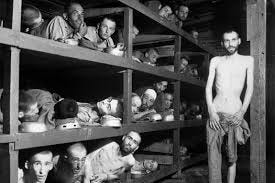
These tributes appear all over the world and serve the same purpose.
When we honor the casualties of war we affirm that they were heroes, not victims, and that the cause was noble. It’s why Reagan, when visiting Germany in 1985 found it natural to honor the graves at a German military cemetery for World War 2 casualties. After all, they loved their country too, right? And Germany is our ally now.
The truth is that any German conscripted into the Wehrmacht had no choice and this has been true for draft-age men of most countries. Under the Nazis the punishment for draft resistance was decapitation2. It didn’t matter how much or how little one loved the Fatherland, the Fuehrer or the Nazi government, he still had to serve the purpose of an industrial elite and an elected madman.
And this coercion was supplemented by a sense of ethnic superiority cultivated over generations, propaganda that Germany was the victim of other nations, anti-semitism, and religious leadership that blessed the war effort — standard equipment for a soldier of the Third Reich included the Gospel of John and a belt buckle inscribed with “Gott mit uns.” (God is with us)
But for Reagan and most political leaders, and for all who are limited to what they’ve learned from family, schools, church, and media, “my country right or wrong” is the definition of patriotism. And patriotism, we are taught, is a most noble quality.
Why?
Because nationalism, the illusory unity of all classes in a country, is a larger scale version of the racial identity scam that the American ruling-class has encouraged (and enforced) since 1619 to prevent white workers from uniting with people of color who share their class position and oppression.
The greatest threat to the wealthy and the power-brokers of the world is the international unity of poor and working-class people. Tribalism, nationalism, and religious identities prevent this unity and “justify” the wars that are fought in their name. War is a small price to pay for preserving these false collective identities. In fact, it’s no price at all. The ruling class profits from wars.
Wars Change Very Little
When I consider the futility of America’s wars I am struck first by the American Revolution, which was certainly not a revolution — the class structure remained untouched. If we call it instead a War of Independence, we have to ask, independence for whom?
Despite the deaths of approximately 25,000 American forces and a similar number of British regulars, the new nation preserved slavery and a rapacious appetite for land already inhabited by the indigenous people of the continent.
In Great Britain (and Canada) slavery would be outlawed in 1833, twenty-two years earlier than in the U.S. and without the horrendous bloodshed of a Civil War. It’s conceivable that slavery would have ended earlier in the U.S. if independence hadn’t been achieved in the 18th century.
And what could have happened if non-violent resistance to the imperial power had been pursued instead? Despite the differences in eras, how can the Indian independence movement help us understand how non-violent resistance might have worked in the American context?
The Civil War killed over 600,000 soldiers. Although most Americans view the Civil War as a righteous struggle that freed the slaves, twelve years later elites in the party of Lincoln traded the rights of freed slaves for an electoral college victory for Rutherford Hayes. This “Compromise” ushered in another form of slavery for three more generations of African-Americans.
It was the non-violent resistance of the Civil Rights movement that brought about the more profound changes.
War leads to more war. WW2 is the “good war” in U.S. history, even with the 80 million global casualties. We are taught that this war of necessity justified even the carpet bombing of cities such as Dresden and Tokyo and the still unimaginable annihilation of 100,000 civilians, including tens of thousands of children, in Hiroshima and Nagasaki and the agonizing death of 100,000 more from radiation poisoning.
This war would not have occurred without the previous world war just twenty years earlier, the causes of which have been trivialized in our history books as the assassination of some duke. No, the cause of the war was imperialism — a struggle for the power to exploit the resources of developing nations. This was also literally a contest between relatives in ruling families of Europe who had the little people to fight for them.
WWI Trench Warfare
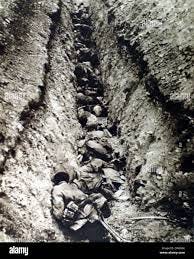
So when I am reminded to honor the fallen of our country’s wars I say instead, let’s make sure that we take care of the living veterans of those wars and work well to heal the physical, psychological and spiritual wounds that afflict them.
And let’s be honest about war — that it is hell and that it is almost always fought on false pretences and promises and in the interests of the ruling class.
Hanoi, after U.S. Christmas Bombing (1972)
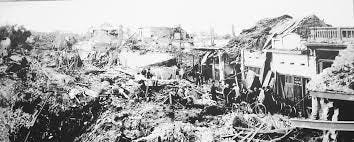
To stand against nationalism and unreflective patriotism is difficult but we can take some inspiration from Thomas Paine who wrote, “He who does not offend cannot be honest,” and “The world is my country, all mankind are my brethren, and to do good is my religion.
***** poems *****
i sing of Olaf glad and big
whose warmest heart recoiled at war:
a conscientious object-or
his wellbelovéd colonel(trig
westpointer most succinctly bred)
took erring Olaf soon in hand;
but--though an host of overjoyed
noncoms(first knocking on the head
him)do through icy waters roll
that helplessness which others stroke
with brushes recently employed
anent this muddy toiletbowl,
while kindred intellects evoke
allegiance per blunt instruments--
Olaf(being to all intents
a corpse and wanting any rag
upon what God unto him gave)
responds,without getting annoyed
“I will not kiss your fucking flag”
straightway the silver bird looked grave
(departing hurriedly to shave)
but--though all kinds of officers
(a yearning nation’s blueeyed pride)
their passive prey did kick and curse
until for wear their clarion
voices and boots were much the worse,
and egged the firstclassprivates on
his rectum wickedly to tease
by means of skilfully applied
bayonets roasted hot with heat--
Olaf(upon what were once knees)
does almost ceaselessly repeat
“there is some shit I will not eat”
our president,being of which
assertions duly notified
threw the yellowsonofabitch
into a dungeon,where he died
Christ(of His mercy infinite)
i pray to see;and Olaf,too
preponderatingly because
unless statistics lie he was
more brave than me:more blond than you.
E.E. Cummings (1962)
What I Wish I’d Told My Draft Board
I’m RSVP-ing no to your invite to war.
It’s simply too far from what my life is for.
I have things I’m called to do and people I love
so, before we get all push and shove,
I won’t be able to make it to your war.

I know you want to tell me what this war is all about
but before you get all red-faced and start to shout,
I’ve studied this and learned what war is for –-
corporate profiteers and political whores.
So, sorry, just can’t make it to your war.

You’ll say it’s all about freedom and liberty
but conscription doesn’t seem that much like freedom to me.
You can call me a coward, but I won’t bite.
Say I don’t love my country ... and you might be right.
But I will not fight in your bullshit war.

I have affection for my fellow Americans
but I’d feel the same if I met some Cambodians.
You can say I put the burden on someone else
but I can make decisions only for myself.
And I’ve decided no to your invite to war.

You say we gotta keep all our eyes on them
or else they’ll come and get us in the end.
Say I’m unpatriotic and that it’s not right
but I won’t shoot people just because they’re not white.
So, I’m not gonna fight in your racist war.

You say our economy’s goin’ kinda slow
and it needs a boost to get it on the go.
You’d like new markets for your wares
and cheap labor costs so you can send our jobs there
but I’m not gonna die for billionaires.

Now you say we’re running low on Texas tea
and we gotta get some from our newly sworn enemy.
Say we’ll be freezing, even run low on food
but I’m not gonna kill for more barrels of crude.
And I will not fight in your stupid war.

If our country were ever truly under threat
by a malevolent force that could be the worst one yet,
then I guess I’d do what I had to do
but that hasn’t been the case since World War 2
so I got no need to fight in your jive-ass war.

You say a pacifist is really just a cheat
who wants all the goods without taking any heat.
I still don’t think you’ve got me right.
I’m not completely non-violent but I pick my own fights
and I’m not gonna fight in your fucking war.

Regrets.
J.R.
For the Fatherland. They gave their lives for us. For God and Country.
Franz Jägerstätter, an Austrian farmer and very devout Catholic - he went to mass daily -was the only man to refuse induction into the German armed forces. He was married and the father of three. He was executed at age 36 in August, 1943. Gordon Zahn’s book, In Solitary Witness: The Life and Death of Franz Jägerstätter (1964)is an excellent biography. Terence Malick directed A Hidden Life (2019), a powerful, contemplative and critically acclaimed film on Jägerstätter’s life.
Well, the Iraq War I choice, though solid so far as the US motive goes,is marred by execution, namely by the US use to kick off military action of "nearly nuclear" Fuel Air Explosive to incinerate and asphyxiate front-line Iraq's troops. (See Michael Kinsley, "Dead Iraqis," New Republic, March 18, 1991; Zahn, G. C. (1992). Ethics, morality, and the Gulf War. St. John's Law Review, 66(3), pp. 883–899.)
This is so powerful, Jim. History, poetry, and reflection. Thank you! I will buy you coffee and more if I ever get back to Boston.